To see many more pictures of Egypt and all our trip, click on the link to our Flickr site. The link is below the archives on the right of this page.
There are also links to maps of India and Egypt.
Saturday, April 14, 2007

Luxor by Ann & Steve
April 8.
Egypt...where to start? Everything seems to be going as planned. The trip from Nepal to Egypt was smooth if a bit long. We got flights with Air Arabia, the deep discount airline of the middle east, (in flight service is one glass of water) to Sharjah, where we ate the last of our Nepali sandwiches and waited 8 hours till midnight to get our connection to Luxor. The flight took 3 hours but each of us snapped up three seats to sleep on. We got into Luxor at 2 am which was 5 am Nepal time, found a cab to the hotel and collapsed. In the morning we were disappointed to find out that the pool was closed so we moved down the street to the St. Joseph Hotel whose pool is open. It is soooo hot here, up near 40 degrees in the pm, that afternoon swims are much appreciated.
Luxor is the ancient Egyptian city of Thebes, famous for its grand monuments and we have managed to get a good overview. We get up with the call to prayers at 5 am and head out to see the sights while it’s cool. We have seen the Valleys of the Kings, Queens, Nobles and Workers as well as Karnak and Hatshupsut’s Temple. The first day we went to Karnak, a temple complex that was started over 4000 years ago and added to by successive pharoahs each trying to outdo his or her predecessor. The scale of everything is mind-boggling and we had fun playing tag in the the famous hall of pillars which I am sure was used for chase scenes in James Bond and Indiana Jones movies. By 11am we were feeling baked and headed for lunch at Chez Omar, a small cafe with French speaking waiters serving Egyptian fare. Then to the pool and a nap.
Next morning we started with a ferry ride over the Nile where we rented bicylces to tour the tombs of the West Bank. As it was Friday, the muslim holy day, the streets were particularly quiet with not many cars or buses, in fact there were more donkeys with wagons bringing things to the market. We started at some tombs of of the workmen who built the Pharoah’s tombs and were most impressed by the tomb of an artist who had painted very detailed, bright and lively scenes on his small and otherwise humble resting place. Next, to the valley of the Nobles where the tombs were a bit bigger, and mercifully easier to get into, but with amazingly clear paintings depicting their lives. Finally we saw two tombs in the valley of the queens which had much larger rooms with complex paintings, but were more deteriorated than we had seen earlier, probably because they had been looted and open to the elements much longer.
By noon we were hot and hungry, but soon found a terrific place for lunch in a shaded spot under a 600 year old tree. Mohamed’s is a typical Egyptian restaurant with big setees under an outdoor arbour. There were only two choices on the menu- chichen or lamb- each with a salad, rice and vegetables plus cake and tea for dessert. The food was delicious, the surroundings so relaxed that we could have had a nap there, but instead we got back on our bikes, took a quick ferry ride home and plunged into the pool. Our hotel rooftop has an amazing view of the Nile. In the morning you can see the hot air ballons floating tourists around and at sunset there are a flotilla of faluccas cruising the river.
Next day we went back to the west bank to see the star attraction of Luxor, the Valley of the Kings. Hidden in the most desolate spot imaginable it is an amazing that the little doorways into the mountains lead into such huge marvelous rooms all carved out of the rock. The three tombs we chose to visit all had exquisite paintings of elaborate scenes adorning the walls of the many halls that one held the possesions and remains of the Pharoahs. Only one still had the sarcophagus, a ten tonne piece of sculpted granite that was more than 100 m underground. Having done a brief tour of a few tombs I could imagine reading up and going for a longer tour with an expert guide, but that will have to wait for another visit. We chose not to see Tutenkamun’s tomb as our book said it is not as spectacular as many of the others and probably not worth the extra $25 entrance fee.
Getting to Valley of the Kings early was a good idea as we were ahead of the crowds and done by 8:30 am when it was still cool enough to climb up over the mountain and down the other side to Hatshepsut’s Temple. The book described it like walking on a lunar landscape, very stark and barren (and hot even at that hour) but the view of the Valley of the Kings on one side and of the green fields adjacent to the Nile and Luxor on the other side is breath-taking. Coming down the views of Hatshepsut’s Temple were terrific too, better than our actual visit inside the temple.
That afternoon we went to lunch at an Egyptian family’s home. Our waiter from the night before, Mohamed, had extended the invitation and although we were a bit unsure, he seemed genuine so we accepted. He met us near our hotel with his 2 year old son and we drove to his village, which was only about 2 km, but a world away from the tourist strip of Luxor. We had an amazing lunch with a salad, rice, bread and a beef stew cooked in an earthen pot called a tagen, along with watermelon and ice-cream for dessert and of course tea. He has four kids from 2 to 16. His wife is a lovely woman with a beautiful smile and perfect teeth (how is it that everyone in India, Nepal and Egypt has lovely teeth?) who wore lots of gold jewlery (which Mohamed said was her dowery) and who makes the most delicious bread! It was so good, we asked her if we could take home a loaf.
Mohamend joined us at the table to be polite but he told us that he had eaten before he picked us up. His wife, having spent the morning preparing the food. relaxed on the floor watching television with the kids. After lunch the kids played together. Mohamed showed us around his simple 3 bedroom appartment and graciously answered all our questions about life in Luxor. Tourism is the only industry and when it is down (as it has been the last few years because of the bombings), everyone is affected. Hence, Mohamed’s side-line business of inviting tourists into their home for an ”authentic Egyptian” experience. That evening we were still full so we ate the bread for supper with cheese, vine ripened delicious tomatoes and cucumbers and baclava for desert which we had bought in the souk. We are enjoying the abundance of fresh veg and fruit after Nepal.
This morning, the Easter Bunny found us in Luxor and after a chocolate high, we retired to the pool for an hour before hitting the school books. Today is a day off from touring to relax. Tonight we are going out to a fancy restaurant for our Easter Dinner with Rob Switzer and his family. Rob is a friend of Steve’s who lives in Cairo and is in Luxor for the long weekend.
Our introduction to the ancient monuments of Egypt complete, tomorrow we leave Luxor by overnight train to Cairo. Rob has arranged for us to have the AUC flat for visiting professors for a week (not sure if I will have to give a guest lecture) and we are looking forward to our time in Cairo, (we hear it is cooler!) where we will see the Pyramids, the Egyptian Museum, and many other sights in that city of 14 million.
Egypt...where to start? Everything seems to be going as planned. The trip from Nepal to Egypt was smooth if a bit long. We got flights with Air Arabia, the deep discount airline of the middle east, (in flight service is one glass of water) to Sharjah, where we ate the last of our Nepali sandwiches and waited 8 hours till midnight to get our connection to Luxor. The flight took 3 hours but each of us snapped up three seats to sleep on. We got into Luxor at 2 am which was 5 am Nepal time, found a cab to the hotel and collapsed. In the morning we were disappointed to find out that the pool was closed so we moved down the street to the St. Joseph Hotel whose pool is open. It is soooo hot here, up near 40 degrees in the pm, that afternoon swims are much appreciated.
Luxor is the ancient Egyptian city of Thebes, famous for its grand monuments and we have managed to get a good overview. We get up with the call to prayers at 5 am and head out to see the sights while it’s cool. We have seen the Valleys of the Kings, Queens, Nobles and Workers as well as Karnak and Hatshupsut’s Temple. The first day we went to Karnak, a temple complex that was started over 4000 years ago and added to by successive pharoahs each trying to outdo his or her predecessor. The scale of everything is mind-boggling and we had fun playing tag in the the famous hall of pillars which I am sure was used for chase scenes in James Bond and Indiana Jones movies. By 11am we were feeling baked and headed for lunch at Chez Omar, a small cafe with French speaking waiters serving Egyptian fare. Then to the pool and a nap.
Next morning we started with a ferry ride over the Nile where we rented bicylces to tour the tombs of the West Bank. As it was Friday, the muslim holy day, the streets were particularly quiet with not many cars or buses, in fact there were more donkeys with wagons bringing things to the market. We started at some tombs of of the workmen who built the Pharoah’s tombs and were most impressed by the tomb of an artist who had painted very detailed, bright and lively scenes on his small and otherwise humble resting place. Next, to the valley of the Nobles where the tombs were a bit bigger, and mercifully easier to get into, but with amazingly clear paintings depicting their lives. Finally we saw two tombs in the valley of the queens which had much larger rooms with complex paintings, but were more deteriorated than we had seen earlier, probably because they had been looted and open to the elements much longer.
By noon we were hot and hungry, but soon found a terrific place for lunch in a shaded spot under a 600 year old tree. Mohamed’s is a typical Egyptian restaurant with big setees under an outdoor arbour. There were only two choices on the menu- chichen or lamb- each with a salad, rice and vegetables plus cake and tea for dessert. The food was delicious, the surroundings so relaxed that we could have had a nap there, but instead we got back on our bikes, took a quick ferry ride home and plunged into the pool. Our hotel rooftop has an amazing view of the Nile. In the morning you can see the hot air ballons floating tourists around and at sunset there are a flotilla of faluccas cruising the river.
Next day we went back to the west bank to see the star attraction of Luxor, the Valley of the Kings. Hidden in the most desolate spot imaginable it is an amazing that the little doorways into the mountains lead into such huge marvelous rooms all carved out of the rock. The three tombs we chose to visit all had exquisite paintings of elaborate scenes adorning the walls of the many halls that one held the possesions and remains of the Pharoahs. Only one still had the sarcophagus, a ten tonne piece of sculpted granite that was more than 100 m underground. Having done a brief tour of a few tombs I could imagine reading up and going for a longer tour with an expert guide, but that will have to wait for another visit. We chose not to see Tutenkamun’s tomb as our book said it is not as spectacular as many of the others and probably not worth the extra $25 entrance fee.
Getting to Valley of the Kings early was a good idea as we were ahead of the crowds and done by 8:30 am when it was still cool enough to climb up over the mountain and down the other side to Hatshepsut’s Temple. The book described it like walking on a lunar landscape, very stark and barren (and hot even at that hour) but the view of the Valley of the Kings on one side and of the green fields adjacent to the Nile and Luxor on the other side is breath-taking. Coming down the views of Hatshepsut’s Temple were terrific too, better than our actual visit inside the temple.
That afternoon we went to lunch at an Egyptian family’s home. Our waiter from the night before, Mohamed, had extended the invitation and although we were a bit unsure, he seemed genuine so we accepted. He met us near our hotel with his 2 year old son and we drove to his village, which was only about 2 km, but a world away from the tourist strip of Luxor. We had an amazing lunch with a salad, rice, bread and a beef stew cooked in an earthen pot called a tagen, along with watermelon and ice-cream for dessert and of course tea. He has four kids from 2 to 16. His wife is a lovely woman with a beautiful smile and perfect teeth (how is it that everyone in India, Nepal and Egypt has lovely teeth?) who wore lots of gold jewlery (which Mohamed said was her dowery) and who makes the most delicious bread! It was so good, we asked her if we could take home a loaf.
Mohamend joined us at the table to be polite but he told us that he had eaten before he picked us up. His wife, having spent the morning preparing the food. relaxed on the floor watching television with the kids. After lunch the kids played together. Mohamed showed us around his simple 3 bedroom appartment and graciously answered all our questions about life in Luxor. Tourism is the only industry and when it is down (as it has been the last few years because of the bombings), everyone is affected. Hence, Mohamed’s side-line business of inviting tourists into their home for an ”authentic Egyptian” experience. That evening we were still full so we ate the bread for supper with cheese, vine ripened delicious tomatoes and cucumbers and baclava for desert which we had bought in the souk. We are enjoying the abundance of fresh veg and fruit after Nepal.
This morning, the Easter Bunny found us in Luxor and after a chocolate high, we retired to the pool for an hour before hitting the school books. Today is a day off from touring to relax. Tonight we are going out to a fancy restaurant for our Easter Dinner with Rob Switzer and his family. Rob is a friend of Steve’s who lives in Cairo and is in Luxor for the long weekend.
Our introduction to the ancient monuments of Egypt complete, tomorrow we leave Luxor by overnight train to Cairo. Rob has arranged for us to have the AUC flat for visiting professors for a week (not sure if I will have to give a guest lecture) and we are looking forward to our time in Cairo, (we hear it is cooler!) where we will see the Pyramids, the Egyptian Museum, and many other sights in that city of 14 million.
Monday, April 09, 2007
Luxor par Rob

Luxor, Egypte
Une partie de Luxor s’appelle la ville des morts parce que tous les tombeaux sont dans les vallées à la rive Ouest du Nil.
Il y a beaucoup de différentes sortes de tombeaux, comme ceux des Pharaons, Reines, les Nobles et même les ouvriers.
 Les décorations sont très belles et elles sont toutes peintures sur les murs. Les dessins montres les dieux avec celui qui est enterré dans les tombeaux.
Il y avait deux tombeaux qui m’ont touché le plus. Ils étaient ceux de Sennofer et Tuthmosis IV. Sennofer était un Noble et les couleurs des peintures étaient très vives. Tuthmosis IV était un Pharaon et son tombeau descend et descend très profond dans la montagne. Au fond était son sarcophage fait de granite rouge qui pense 10 tons et qui a beaucoup de petits signes gravées dessus.
Nous avons marché sur le sentier qui passe au-dessus des montagnes entre la vallée des Rois et le temple de Hatshepsut.
 Au temple de Karnak, il y a des sections qui date de 4000 ans. Incroyable!!! Nous avons joué à ‘’tag’’ dans le champ des 130 énorme colonnes.
La première journée nous avons loué des vélos pour se rendre aux vallées des tombeaux. C’était vraiment excitant de descendre au Nil après notre visite.
Sunday, April 08, 2007
Baktapur by Kathleen

In Baktapur, we stayed at the Golden Gate House which is close to a gate into the palace carved out of gold. It was a very pleasant stay. Baktapur is half an hour away from Kathmandu and is quieter and less modernized. The sightseeing in was incredible. 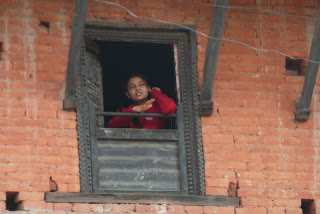 To see the doors and windows carved out of wood and gold was really impressive. The kings during the 17th century ordered the work to be done.
All the squares have most extraordinary temples with high roofs that come out. The streets are similar to the ones in Varanasi, very narrow and windy. Around one bend we came upon a group of ladies knitting mittens exactly like the ones we bought in Kathmandu for our trek. Some of the ladies knitting were in fact girls not much older than me. They told us it takes them two hours to knit the mittens, however we are not sure if that is two hours for one mitten or for a pair.
For breakfast every day we ate some famous, thick, rich Baktapur curd (yoghurt) with fruit on our muesli and curd and apple on delicious crepes. My absolute favourite part of Baktapur was eating breakfast with lots of curd while on the roof of our hotel overlooking this amazing old city!
 To see the doors and windows carved out of wood and gold was really impressive. The kings during the 17th century ordered the work to be done.
All the squares have most extraordinary temples with high roofs that come out. The streets are similar to the ones in Varanasi, very narrow and windy.
 Around one bend we came upon a group of ladies knitting mittens exactly like the ones we bought in Kathmandu for our trek. Some of the ladies knitting were in fact girls not much older than me. They told us it takes them two hours to knit the mittens, however we are not sure if that is two hours for one mitten or for a pair.
For breakfast every day we ate some famous, thick, rich Baktapur curd (yoghurt) with fruit on our muesli and curd and apple on delicious crepes. My absolute favourite part of Baktapur was eating breakfast with lots of curd while on the roof of our hotel overlooking this amazing old city!
Rafting on the Trisuli River, Nepal

When we went rafting, I found it was so exciting because we were zooming down the rapids. Some had huge rooster tails and we got splashed all over, but luckily we never fell out.
Once, on a flat part of the river, Dad, Kathleen and I jumped out of the raft and floated down the river with our life jackets on. Brrr, the water was cold.
 We camped for the night on a beautiful white sandy beach where Kathleen and I dug a huge hole and made water slides.
The raft was controlled by our guide, Balsain, who knew Daddy from 20 years ago. He used oars to steer the raft down the river and into the rapids! Balsain also prepared delicious meals for us. It was a great rafting experience. I hope to do it again.

By Robert
Once, on a flat part of the river, Dad, Kathleen and I jumped out of the raft and floated down the river with our life jackets on. Brrr, the water was cold.
 We camped for the night on a beautiful white sandy beach where Kathleen and I dug a huge hole and made water slides.
The raft was controlled by our guide, Balsain, who knew Daddy from 20 years ago. He used oars to steer the raft down the river and into the rapids! Balsain also prepared delicious meals for us. It was a great rafting experience. I hope to do it again.

By Robert
Nepal Agriculture et batiments

Agriculture
L’agriculture au Nepal est très différente qu’au Canada. L’agriculture au Canada est faite aux endroits plats, au Nepal il n’y a pas d’endroits plats et comme ça ils font des terrasses qui ressemblent à des énormes escaliers.
 Pour préparer la terre ils trouvent un endroit avec de la bonne terre, et ils coupent les terrasses. Les terrasses finies, ils tournent le sol à la main ou à l’aide des bœufs, et l’enrichissent avec du fumier.
Ils cultive différents choses dépendant de la saison. Le riz est normal au mousson quand les champs sont inondés. Nous avons vu les champs avec du blé mûr qui est cultivé en hiver, et aussi des légumes, comme patates, épinards, choux et tomates qui poussent toute l‘année.
Les Nepalais gardent plusieurs animaux. Nous avons vu les buffalos, qui produisent le lait, et leur fumier peut être utilisé pour fumier ou le brûler pour cuisinier. Les Boeufs sont utiles pour tourne le sol. Les moutons et les chèvres donnent du lait, de la viande, et de la laine. Les poules donnes des œufs et de la viande.
 À deux mille mètres d’altitude sont les fruitiers à la pomme, abricot à Marpha et les oranges se trouvent plus bas à Tatopanni.
L’agriculture est très importante dans les villages au Népal parce qu’il n’y a pas de routes dès le monde mangent ce qu’ils cultivent, ou ce qui est importé sur les dos des porters. Pour ces raisons, nous avons bien mange pendant notre trek avec un menu assez élaboré.
L’agriculture au Nepal est très différente qu’au Canada. L’agriculture au Canada est faite aux endroits plats, au Nepal il n’y a pas d’endroits plats et comme ça ils font des terrasses qui ressemblent à des énormes escaliers.
 Pour préparer la terre ils trouvent un endroit avec de la bonne terre, et ils coupent les terrasses. Les terrasses finies, ils tournent le sol à la main ou à l’aide des bœufs, et l’enrichissent avec du fumier.
Ils cultive différents choses dépendant de la saison. Le riz est normal au mousson quand les champs sont inondés. Nous avons vu les champs avec du blé mûr qui est cultivé en hiver, et aussi des légumes, comme patates, épinards, choux et tomates qui poussent toute l‘année.
Les Nepalais gardent plusieurs animaux. Nous avons vu les buffalos, qui produisent le lait, et leur fumier peut être utilisé pour fumier ou le brûler pour cuisinier. Les Boeufs sont utiles pour tourne le sol. Les moutons et les chèvres donnent du lait, de la viande, et de la laine. Les poules donnes des œufs et de la viande.
 À deux mille mètres d’altitude sont les fruitiers à la pomme, abricot à Marpha et les oranges se trouvent plus bas à Tatopanni.
L’agriculture est très importante dans les villages au Népal parce qu’il n’y a pas de routes dès le monde mangent ce qu’ils cultivent, ou ce qui est importé sur les dos des porters. Pour ces raisons, nous avons bien mange pendant notre trek avec un menu assez élaboré.
Bâtiments
 Les maisons au Népal sont très différentes qu’au Canada, parce que le climat est différent et aussi les matériaux utilisés. Dans les montagnes, les bâtiments sont faits de pierre taillée pour les rendre plats. Les gens mettent de la boue entre les pierres et non pas du ciment parce que le ciment est trop lourd d’apporter dans les montagnes.
Pour le type de toit, ça dépend ou les maisons sont situées. Si les maisons sont à côté de la rivière et loin des routes, les gens utilisent les bardons de pierres. Si les maisons sont très nouvelles ou proches des routes les toits sont fabrique en métal.
 Aussi, la paille fait de la bonne isolation et elle est utilisée pour faire le toit quand la maison est proche d’ou elle peut la pousser. Aux endroits secs, les toits sont plats et faits avec de la boue.
J’étais impressionné de la façon que les Népalais utilisent ce qu’il y a autours d’eux pour faire construire leurs maisons.
 Les maisons au Népal sont très différentes qu’au Canada, parce que le climat est différent et aussi les matériaux utilisés. Dans les montagnes, les bâtiments sont faits de pierre taillée pour les rendre plats. Les gens mettent de la boue entre les pierres et non pas du ciment parce que le ciment est trop lourd d’apporter dans les montagnes.
Pour le type de toit, ça dépend ou les maisons sont situées. Si les maisons sont à côté de la rivière et loin des routes, les gens utilisent les bardons de pierres. Si les maisons sont très nouvelles ou proches des routes les toits sont fabrique en métal.
 Aussi, la paille fait de la bonne isolation et elle est utilisée pour faire le toit quand la maison est proche d’ou elle peut la pousser. Aux endroits secs, les toits sont plats et faits avec de la boue.
J’étais impressionné de la façon que les Népalais utilisent ce qu’il y a autours d’eux pour faire construire leurs maisons.
par Robert
Thursday, April 05, 2007
Trekking in Nepal Mar 6-27

Trekking in Nepal is like nothing else in the world. It is a mix of incredible vistas, awe-inspiring geology and a rich variety of cultural interactions. It is not a wilderness experience and so one constantly meets other people on the trails, particularly in Kali Gandaki Valley, which is an ancient trading and pilgrimage route. The trails a busy with fellow trekkers, Nepalis going back to their village for a wedding or festival, villagers going to and from their fields, pilgrims heading to Muktinath (some wearing only a loincloth and carrying a rice bowl), porters and mule trails ferrying supplies up to remote villages.
The villages, with narrow stone walkways are captivating and provide a window into traditional Nepali life. As in places where houses are primitive, the Nepali villagers live much of their life out in public. At the local water source women wash clothes, dishes and particularly, their hair. On their front steps and doorways, people spin wool, weave carpets, play a Nepali version of Chrokinole, mend fishing nets, make baskets and boil raksi (the local wine) while chatting and sharing tea with neighbours. We met children running up and down the stone steps, heading to and from school in their matching uniforms, always polite and always smiling. And what beautiful faces and smiles! It is said that visitors to Nepal come first for the mountains and return for the people! The Nepalese are warm, helpful, caring, generous people. We witnessed acts of kindness and generosity by those that we met and as well, by our guide and porter for
  our trek. During a rainstorm a family invited us into their kitchen to drink tea, warm our toes and dry our clothes over hot coals. For Kate’s birthday, our guide, Raj Kumar, ordered a special cake and carried it in a box eight hours the next day so that she would be sure to have a special treat on her birthday. Our porter Vishnu, after having carried seventy pounds of our luggage, could often be found at the end of a day’s trek helping lodge owners by using his command of English to show rooms to potential guests or by helping to serve dinner.
 We were a bit worried if we could handle such a long trek staying in the primitive lodges. Steve had warned us about 3 weeks sleeping in smelly dormitories without a shower and eating nothing but rice and dhal. Fortunately the lodges have much improved since his last visit with most having electricity, many having hot water and all serving a varied menu. Some of the better places made apple pie and served sizzling steaks! One place we stayed for $1 a night even had glass windows and amazing views of the mountains.
Another high point of the trek was meeting all the other adventurous people and hearing their stories as we sat around the supper tables in the lodges. We learned to play Skaad from some Germans and Kathleen taught a group of young American and Canadian volunteers to play Euchre. We met so many interesting people including an Australian couple finishing up a three year trip around the world, a Japanese man who was working his way around the world by working on organic farms through the organization WOOF, including 6 months in Nelson, B.C. He said that working your way around the world was a great way to get to know the local population and to see the world on a budget. A sixty-year old Dutch mother trekking and mountain biking with her daughter and their guide was the Nepali orphan they had sponsored 15 years earlier. And, most impressing, an American couple trekking with their 7 year old, 4 year old and yes, 1 year old!

How does one sum up our trek in Nepal? Fantastic!
First, it’s a great way to spend a holiday together as a family and in many ways the best part of the trek was the time spent together. Whether two by two, or on wider paths all together, or even from time silently lost in your own thoughts, trekking is a wonderful way to just be together. We had lots of time to discuss the sights we were seeing and to figure out how suspension bridges are made, why the bamboo grows in the valley, how the tiny electricity generators and flour mills work by water power, and so on. The kids had lots of questions. Some of the questions we couldn’t answer, but with the help of Raje, Vishnu and the many Nepalese we met we all learned lots about the land and how it affects life in Nepal.
We also talked in great length about future plans, about school next year and what it will be like to be back home with family and friends (whom we miss) and about getting a family dog (we are getting closer to a consensus). Each day brought surprises, challenges and each of us were tested in new and different ways.

Trekking is also a great way to get into shape and is a complete break from the regular routine of work, meals, housework, shuttling kids, etc. In the mornings, once the bags are packed, you are free for the day with no worries other than deciding what to order for meals along the way (and as every lodge has the same menu, the choices are limited). The walking is exhilarating. Other than stopping for meals, tea breaks and sleeping, you are climbing up and down. It is like being on a Stairmaster for 6 hours a day, but that is where the similarity ends. In Nepal the c limbing (gentle climbing up and down is referred to as “Nepali flat”) involves enjoying the spectacular scenery while you are huffing and puffing along. Everywhere you look is an impressive vista and around each bend is a new mountain panorama. As temperatures soared in the valley or dipped on alpine terrain, we passed orchards and orchids, rice paddies and high pasture, pine and bamboo forests (great for finding walking sticks), bougainvillea trees, snow and ice. Every day you feel better than the last and every night you hit the pillow by 9:00 pm, exhausted but happy.
The culmination of our trek was the Annapurna Sanctuary. Our original plan was to head straight up towards the Sanctuary at the beginning of the trip and, if we had time afterwards, to make a side-trip to the Kali Gandaki Valley (KGV). Reports of heavy snow in the Sanctuary led us to make a last minute route change and to start in the KGV. This ended up being a very good choice in more ways than one. Our thoughts of the snow melting did not materialize, but the 10 days we spent over in the KGV got us used to life on the trail, allowed us to get our trekking legs so we could hike up and down hills for 6 hrs and having climbed over 3000 m on two separate occasions, helped us acclimatized to altitude, so by the time we reached the Annnapurna Sanctuary, we were fit and mentally prepared for the tough days at altitude.
On day ten we crossed the pass at Gorepani and headed towards Annapurna Base Camp (ABC) not knowing if the pass into the Sanctuary was even open, due to the continued rain (and therefore snow in the Sanctuary). With ever increasing excitement and anticipation, each day we went up higher and into colder temperatures. At night we huddled around heated tables drying our gear before heading to sleep in our cold, candle lit room. Waking at day-break each morning and hiking all day meant it was no problem to fall asleep at night. We encountered our first deep snow at Deurali where we were able to rent gaiters. The next morning was the big day. We were up and on the trail by 7 am to get by the four possible avalanche plumes before the sun hit them. It was an icy two-hour walk to Machupuchare Base Camp (MBC) where we arrived just as the sun came over the mountaintops. A quick bite and we headed on to ABC. Amazing, breathtaking, awesome! We were alone on the trail, which snakes up along the ridge to get by another avalanche plume. Once by that, we breathed a big sigh of relief and relaxed so that we could enjoy the sights around us. The Sanctuary, so named because you are in a bowl surrounded by massive peaks of rock, snow and ice is also referred to as the Cathedral with spires. With no wind it was a quiet, mystical, magical place. We walked in brilliant sunshine, which was reflecting off the snow in every direction and we kept peeling the layers off as the temperature shot up to 22 degrees. We
  arrived exhausted, but exhilarated, at ABC at 1 pm, to be treated to one of the tastiest lunches of the previous two weeks. We wrung out our socks and tried to ready ourselves for the hike back to MBC. By 2 pm it had clouded over which was a blessing as it slowed the softening of the snow and made our trip back a delight. Instead of sinking up to our hips on every step, which we had heard reports of from other trekkers, we were able to slide back down in our wet (and I mean wet) trekking shoes (not boots!). It only took an hour for the return trip and even though our feet were wet, they were not cold. It was like skiing but very funny with face plants and mittens flying. We arrived back at MBC (by the avalanche plume safely once again) feeling like we were on top of the world (we almost were!). Around the dinner table that night with other successful trekkers we shared the communal feeling in the air of the success of having just been in one of the world’s truly special places, the Annnapurna Sanctuary. Despite the burnt noses, sore legs and avalanche scares it was mission accomplished.
The villages, with narrow stone walkways are captivating and provide a window into traditional Nepali life. As in places where houses are primitive, the Nepali villagers live much of their life out in public. At the local water source women wash clothes, dishes and particularly, their hair. On their front steps and doorways, people spin wool, weave carpets, play a Nepali version of Chrokinole, mend fishing nets, make baskets and boil
 raksi (the local wine) while chatting and sharing tea with neighbours. We met children running up and down the stone steps, heading to and from school in their matching uniforms, always polite and always smiling. And what beautiful faces and smiles! It is said that visitors to Nepal come first for the mountains and return for the people! The Nepalese are warm, helpful, caring, generous people. We witnessed acts of kindness and generosity by those that we met and as well, by our guide and porter for
  our trek. During a rainstorm a family invited us into their kitchen to drink tea, warm our toes and dry our clothes over hot coals. For Kate’s birthday, our guide, Raj Kumar, ordered a special cake and carried it in a box eight hours the next day so that she would be sure to have a special treat on her birthday. Our porter Vishnu, after having carried seventy pounds of our luggage, could often be found at the end of a day’s trek helping lodge owners by using his command of English to show rooms to potential guests or by helping to serve dinner.
 We were a bit worried if we could handle such a long trek staying in the primitive lodges. Steve had warned us about 3 weeks sleeping in smelly dormitories without a shower and eating nothing but rice and dhal. Fortunately the lodges have much improved since his last visit with most having electricity, many having hot water and all serving a varied menu. Some of the better places made apple pie and served sizzling steaks! One place we stayed for $1 a night even had glass windows and amazing views of the mountains.
Another high point of the trek was meeting all the other adventurous people and hearing their stories as we sat around the supper tables in the lodges. We learned to play Skaad from some Germans and Kathleen taught a group of young American and Canadian volunteers to play Euchre. We met so many interesting people including an Australian couple finishing up a three year trip around the world, a Japanese man who was working his way around the world by working on organic farms through the organization WOOF, including 6 months in Nelson, B.C. He said that working your way around the world was a great way to get to know the local population and to see the world on a budget. A sixty-year old Dutch mother trekking and mountain biking with her daughter and their guide was the Nepali orphan they had sponsored 15 years earlier. And, most impressing, an American couple trekking with their 7 year old, 4 year old and yes, 1 year old!

How does one sum up our trek in Nepal? Fantastic!
First, it’s a great way to spend a holiday together as a family and in many ways the best part of the trek was the time spent together. Whether two by two, or on wider paths all together, or even from time silently lost in your own thoughts, trekking is a wonderful way to just be together. We had lots of time to discuss the sights we were seeing and to figure out how suspension bridges are made, why the bamboo grows in the valley, how the tiny electricity generators and flour mills work by water power, and so on. The kids had lots of questions. Some of the questions we couldn’t answer, but with the help of Raje, Vishnu and the many Nepalese we met we all learned lots about the land and how it affects life in Nepal.

We also talked in great length about future plans, about school next year and what it will be like to be back home with family and friends (whom we miss) and about getting a family dog (we are getting closer to a consensus). Each day brought surprises, challenges and each of us were tested in new and different ways.

Trekking is also a great way to get into shape and is a complete break from the regular routine of work, meals, housework, shuttling kids, etc. In the mornings, once the bags are packed, you are free for the day with no worries other than deciding what to order for meals along the way (and as every lodge has the same menu, the choices are limited). The walking is exhilarating. Other than stopping for meals, tea breaks and sleeping, you are climbing up and down. It is like being on a Stairmaster for 6 hours a day, but that is where the similarity ends. In Nepal the c
 limbing (gentle climbing up and down is referred to as “Nepali flat”) involves enjoying the spectacular scenery while you are huffing and puffing along. Everywhere you look is an impressive vista and around each bend is a new mountain panorama. As temperatures soared in the valley or dipped on alpine terrain, we passed orchards and orchids, rice paddies and high pasture, pine and bamboo forests (great for finding walking sticks), bougainvillea trees, snow and ice. Every day you feel better than the last and every night you hit the pillow by 9:00 pm, exhausted but happy.
The culmination of our trek was the Annapurna Sanctuary. Our original plan was to head straight up towards the Sanctuary at the beginning of the trip and, if we had time afterwards, to make a side-trip to the Kali Gandaki Valley (KGV). Reports of heavy snow in the Sanctuary led us to make a last minute route change and to start in the KGV. This ended up being a very good choice in more ways than one. Our thoughts of the snow melting did not materialize, but the 10 days we spent over in the KGV got us used to life on the trail, allowed us to get our trekking legs so we could hike up and down hills for 6 hrs and having climbed over 3000 m on two separate occasions, helped us acclimatized to altitude, so by the time we reached the Annnapurna Sanctuary, we were fit and mentally prepared for the tough days at altitude.
On day ten we crossed the pass at Gorepani and headed towards Annapurna Base Camp (ABC) not knowing if the pass into the Sanctuary was even open, due to the continued rain (and therefore snow in the Sanctuary). With ever increasing excitement and anticipation, each day
 we went up higher and into colder temperatures. At night we huddled around heated tables drying our gear before heading to sleep in our cold, candle lit room. Waking at day-break each morning and hiking all day meant it was no problem to fall asleep at night. We encountered our first deep snow at Deurali where we were able to rent gaiters. The next morning was the big day. We were up and on the trail by 7 am to get by the four possible avalanche plumes before the sun hit them. It was an icy two-hour walk to Machupuchare Base Camp (MBC) where we arrived just as the sun came over the mountaintops. A quick bite and we headed on to ABC. Amazing, breathtaking, awesome! We were alone on the trail, which snakes up along the ridge to get by another avalanche plume. Once by that, we breathed a big sigh of relief and relaxed so that we could enjoy the sights around us. The Sanctuary, so named because you are in a bowl surrounded by massive peaks of rock, snow and ice is also referred to as the Cathedral with spires. With no wind it was a quiet, mystical, magical place. We walked in brilliant sunshine, which was reflecting off the snow in every direction and we kept peeling the layers off as the temperature shot up to 22 degrees. We
  arrived exhausted, but exhilarated, at ABC at 1 pm, to be treated to one of the tastiest lunches of the previous two weeks. We wrung out our socks and tried to ready ourselves for the hike back to MBC. By 2 pm it had clouded over which was a blessing as it slowed the softening of the snow and made our trip back a delight. Instead of sinking up to our hips on every step, which we had heard reports of from other trekkers, we were able to slide back down in our wet (and I mean wet) trekking shoes (not boots!). It only took an hour for the return trip and even though our feet were wet, they were not cold. It was like skiing but very funny with face plants and mittens flying. We arrived back at MBC (by the avalanche plume safely once again) feeling like we were on top of the world (we almost were!). Around the dinner table that night with other successful trekkers we shared the communal feeling in the air of the success of having just been in one of the world’s truly special places, the Annnapurna Sanctuary. Despite the burnt noses, sore legs and avalanche scares it was mission accomplished.
Annapurna Sanctuary by Rob


Day 16 was a day I had been looking forward to because we were going to be up in the Annapurna Sanctuary. We got up really early so that we could pass the avalanches before the sun hit them. In the morning the snow is very icy so that if you slipped you could fall into the river. Some of the bridges over the river were unstable. After two hours of hiking on icy snow covered trails, we finally got to Machupuchare Base Camp (MBC) at 3700m.
We arrived at MBC and were into the Annapurna Sanctuary, it was spectacular! We were half way up Annapurna, an 8000m peak, with another 4000 m of snow, rock and ice reflecting the sun making it the brightest time in my life. As the sun hit everything it started to melt. Normally, at this time of year there is no snow so it is much easier and you hike in the bottom of the valley, but because there was lots of snow we had to hike on the top of the ridge so any avalanche would not hit us. For fun and to figure out the principle of avalanches, my sister and I made snowballs and rolled them down the hill. They broke and we made new ones, but we never started an avalanche.
 It took us two hours more to get to Annnapuna Base Camp at 4030m, where we had the best vegetables in our noodle soup and a delicious pizza. With our tummies full, we headed back down to MBC. Going down was so much fun! First, we saw some guys tubing and asked them if we could have a try. Kathleen and I went for two runs and thanked them very much. Then we walked back up onto the ridge and continued down the trail. The sun was strong, which melted the snow and it was much easier to slide down the hill. We were almost skiing in out two boots. I liked it so much that I didn’t care that my boots were getting soaking wet! It took us one hour to get back to MBC safely. My socks were so wet I had to wring them out.
I was so proud of myself because I had been to the Annapurna Base Camp, which I had always wanted to do. At supper time a man from TV5 in France came over to interview us because he was so surprised that children our age had been to the Annapurna Base Camp!

Saturday, March 31, 2007
India Unbound excerpts
We have read an interesting book, India Unbound by Gurcharan Das. First written in 2000 and revised in 2002, Das examines how the economic reforms of 1991 have led to a huge increase in entrepreneurialism and a rising middle class in India. Here are some quotes from the book, which have given us much fodder for discussion. We hope you find them interesting too:
“The theme of this book is how a rich country became poor and will become rich again. India had more than a fifth of the world’s wealth and a quarter of the world’s trade in textiles in 1700. It has seen its share decline to less than 5% of world income and less than half a percent of world trade in 1995. It may not have become poorer in absolute terms but compared to the rest of the world, it did get left behind. We have gotten so used to the inequalities between rich and poor countries that we the astonishing truth that living standards around the world were roughly equal in 1750 –everyone was poor. Even in 1850 things were not very different. Today the average person in the developed world is ten to twenty times richer. This happened …because of the capitalist breakthrough, which began in England between 1760 and 1820 with the invention of the cotton gin and the steam engine, followed by waves of technological innovations…railroad, steamship, steel…electricity…the automobile…the chip and computers. With the emergence of Japan and the Far East in the last quarter century, the world became a global economy.
India did not participate in this great adventure. We grew up believing that our “mixed economy” …though not as efficient as capitalism, was better because it cared for the poor. It was better than communism because it preserved political freedoms. But its problem was of performance, not of faith. If it had worked, most of the third world would be more prosperous today. Indians have learned from painful experience that the state does not work on behalf of the people. More often than not, it works on behalf of itself.” P.348-9
“In Hindu society the Brahmin (priest, teacher) is at the top of the four-caste hierarchy, followed by the Kshatriya (variously landholder, warrior, ruler). The Vaishya or bania (businessman) comes third, and the Shudra (laborer, artisan) is last. Below the four are the casteless “untouchables” and tribals. The three upper castes constitute roughly 15% of India’s population, and have ruled the country for 3000 years. About half of India is laboring or Shudra caste, divided in turn into hundreds of subcastes. Some are occupational-cobblers and carpenters, for example- others are geographic. More than 20% of the population are the casteless or “untouchables” and tribals for whose uplift Mahatma Gandi worked all his life. The remaining 15% of India belongs to other religions: 11 % Muslim, the rest Sikh, Christian, Parsee, etc.” P. 140
“It was estimated that in the mid 90’s the middle or consuming class was 32.5 million households. Since there are roughly 5 persons in a household, this means that the middle class was 169 million or 18% of the population. This household income is between Rs 45,000 and Rs 215,000 (US$ 1,000-5,000) and typically owns a TV, cassette recorder, pressure cooker, ceiling fan, bicycle and wristwatch. Two-thirds of this consuming class owns a scooter, color TV electric iron, blender and sewing machine, but less than half own a refrigerator.
(Of course, the penetration of TV’s, bicycles, radios and fans goes far beyond the middle class-TV’s are in over 62 million homes, bicycles in 80 million, wristwatches in 125 million and fans in 50 million homes.) Most striking is this consuming middle class appears to have tripled in 10 years. This middle class is projected to reach 91 million households by 2007, or 450 million people. “ P. 287
“Poor teamwork is pervasive in India…. I asked my cousin, Usha Kumar, if it had something to do with the Indian personality. She is a trained psychologist and she pointed me to Sudhir Kakar, the author of the Inner World: A Psycho-analytic Study of Childhood and Society in India. Kakar said that it begins with the Indian bride, who is not fully accepted into her husband’s home until she produces a male child. She is so grateful when a son is born that she indulges him to excess. As the boy grows up he remains close to the mother and distant from the father. The end result is that the boy grows up narcissistic and has a weak ego.
The adult Indian male personality that emerges from various psychologists’ accounts has a weak sense of self, one that needs the support of authority figures. He is less comfortable on his own. He needs appreciative, older, hierarchical figures, even late in his professional life.
It is difficult to say how valid this hypothesis is in the absence of broad socio-psychological data. Never-the-less, there seems to be near-universal agreement about this Indian personality among professionals.” P. 43
“Years later, my grandfather admitted that he was a little sad to see the British go and said “It is certainly nice to feel the fresh breeze of freedom, but you must remember, my son, that India had been the best-governed country in the world for a hundred years. Why, Britain itself was not as well ruled because it was, after all, a messy parliamentary democracy, and it was not run by the Indian civil service…. Yes, the English were arrogant, but it was a cheap price to pay for a hundred years of peace, good government, railways, irrigation canals, and the best law and order in the world. You may call me antinational, but this is how I feel.”” P. 52
“In my highschool in Washington I was surprised that we had to attend a class called “shop”. We learned to repair a window, make a table, or unclog a sink. At the end of the year, we had lost our fear of technology. We had understood Bronowski’s dictum that the world is understood through the hand, not the mind-the hand is the cutting edge of the mind. It explains why many Americans are “tinkerers”. This is a powerful idea for India, where we have traditionally had contempt for manual labor because of our caste system.” P.71
“I have found it frustrating that Indian intellectuals and political leaders are so anti-American that they are unable to perceive the qualities of America. The American education system has many flaws, but it is far fairer (and more creative) than most systems.” P. 80
“Although Americans think of themselves as individualistic, they have historically had a rich civil society…They have a dense network of voluntary organizations: churches, professional groups, charitable institutions, neighbourhood clubs and so on. (However, this rich associational life has weakened in the last generation as family life has deteriorated.) In contrast, the social life of Indians revolves around the family or caste. It does not encompass the whole community. Perhaps this is why our streets are dirty when our homes are spotlessly clean.” P. 81
“After the abolition of untouchability in 1950, the most dramatic development relating to caste occurred in 1990. Vishwanath Pratap Singh, the aristocrat turned politician (and able finance minister under Rajiv Gandhi), needed an electoral platform to differentiate himself from other politicians. Socialism had run out of steam. Mrs. Gandhi’s populism had been discredited. Singh looked for a gap and found it in the “backwardness of the “other backward castes” (OBC’s). These were the laboring Shudra majority, fully half the country’s population-barbers, carpenters, cobblers, goat herders, other artisans, and farm labor-who had lacked a political voice. In comparison, the Dalits had already found a voice in politics and there were programs in place to lift them, and the upper castes had always looked after themselves nicely for 3000 years…. The OBC movement spread like wildfire in the north Indian heartland. The upper castes were horrified. Suddenly another 50 % of the government jobs and places in colleges might be denied to them. With 20% of the jobs already reserved for the Dalits, they realized that if the OBC demand succeeded only 30% of future seats would be available on merit. It was an invitation for a caste war. And it came… The logic of the ballot box was too strong. Singh, as Prime Minister of a coalition government, tried to fulfill his election promise, but his attempts to increase reservations became mired in the courts. However, the succeeding Congress government of Narasimha Rao seized the opportunity to win the OBC vote. It enacted legislation raising the reservations of OBCs to 30%. Thus 50% of government jobs and seats in colleges are today based on criteria other than merit.” P.146
Das quoting a childhood teacher and the wisdom he imparted to him. “There are three kinds of knowledge: Knowledge of the world, of the self and of God.
Knowledge of the world came through reason and physical sciences. Knowledge of the self came partially from psychology and the social sciences. But for the knowledge of God one had to turn to the Gita. The Gita taught that knowledge from books was not enough-it had to be combined with action and it had to be experienced.” P. 294
Das commenting on remarks by Public Policy Specialist- Francis Fukuyama about prosperity in the modern, western world.
“There is also a bleak side to Fukuyama’s generally sunny vision. It is that bourgeois life tends to become consumerist, lonely, banal and unheroic. The irony of liberalism is that it gives the individual free space in order to fashion his life, but he is unable to cope with the free space and fills it with trivial objects. Without a God or ideology, bourgeois life is reduced to the endless pursuit of cars, VCRs, cell phones and channel surfing. The reference point is self, and the individual becomes self-absorbed in a world of physical security and rational consumption. Even when it comes to sport and exercise, one prefers to jog rather than play team sports. Without a higher moral purpose, there are no heroic acts to perform. Is this the life that India has to look forward to in this century?
Although India may compress the economic timetable and become prosperous in the next 25 years, I believe it will not lose out o religiosity quite as rapidly as the west and Far East. Religion has a powerful place in Indian life, and the persistence of God will be its strongest defense. However, the challenge will be to keep religion a private matter.”
P. 309
Gurcharan Das is the author of three plays and a novel, A Fine Family (1990). He is also a columnist for the Times of India and other newspapers. He graduated from Harvard College and attended Harvard Business School. A former CEO of Procter & Gamble India, he is currently a venture capitalist and a consultant to industry and government. He lives with his wife in New Delhi.
“The theme of this book is how a rich country became poor and will become rich again. India had more than a fifth of the world’s wealth and a quarter of the world’s trade in textiles in 1700. It has seen its share decline to less than 5% of world income and less than half a percent of world trade in 1995. It may not have become poorer in absolute terms but compared to the rest of the world, it did get left behind. We have gotten so used to the inequalities between rich and poor countries that we the astonishing truth that living standards around the world were roughly equal in 1750 –everyone was poor. Even in 1850 things were not very different. Today the average person in the developed world is ten to twenty times richer. This happened …because of the capitalist breakthrough, which began in England between 1760 and 1820 with the invention of the cotton gin and the steam engine, followed by waves of technological innovations…railroad, steamship, steel…electricity…the automobile…the chip and computers. With the emergence of Japan and the Far East in the last quarter century, the world became a global economy.
India did not participate in this great adventure. We grew up believing that our “mixed economy” …though not as efficient as capitalism, was better because it cared for the poor. It was better than communism because it preserved political freedoms. But its problem was of performance, not of faith. If it had worked, most of the third world would be more prosperous today. Indians have learned from painful experience that the state does not work on behalf of the people. More often than not, it works on behalf of itself.” P.348-9
“In Hindu society the Brahmin (priest, teacher) is at the top of the four-caste hierarchy, followed by the Kshatriya (variously landholder, warrior, ruler). The Vaishya or bania (businessman) comes third, and the Shudra (laborer, artisan) is last. Below the four are the casteless “untouchables” and tribals. The three upper castes constitute roughly 15% of India’s population, and have ruled the country for 3000 years. About half of India is laboring or Shudra caste, divided in turn into hundreds of subcastes. Some are occupational-cobblers and carpenters, for example- others are geographic. More than 20% of the population are the casteless or “untouchables” and tribals for whose uplift Mahatma Gandi worked all his life. The remaining 15% of India belongs to other religions: 11 % Muslim, the rest Sikh, Christian, Parsee, etc.” P. 140
“It was estimated that in the mid 90’s the middle or consuming class was 32.5 million households. Since there are roughly 5 persons in a household, this means that the middle class was 169 million or 18% of the population. This household income is between Rs 45,000 and Rs 215,000 (US$ 1,000-5,000) and typically owns a TV, cassette recorder, pressure cooker, ceiling fan, bicycle and wristwatch. Two-thirds of this consuming class owns a scooter, color TV electric iron, blender and sewing machine, but less than half own a refrigerator.
(Of course, the penetration of TV’s, bicycles, radios and fans goes far beyond the middle class-TV’s are in over 62 million homes, bicycles in 80 million, wristwatches in 125 million and fans in 50 million homes.) Most striking is this consuming middle class appears to have tripled in 10 years. This middle class is projected to reach 91 million households by 2007, or 450 million people. “ P. 287
“Poor teamwork is pervasive in India…. I asked my cousin, Usha Kumar, if it had something to do with the Indian personality. She is a trained psychologist and she pointed me to Sudhir Kakar, the author of the Inner World: A Psycho-analytic Study of Childhood and Society in India. Kakar said that it begins with the Indian bride, who is not fully accepted into her husband’s home until she produces a male child. She is so grateful when a son is born that she indulges him to excess. As the boy grows up he remains close to the mother and distant from the father. The end result is that the boy grows up narcissistic and has a weak ego.
The adult Indian male personality that emerges from various psychologists’ accounts has a weak sense of self, one that needs the support of authority figures. He is less comfortable on his own. He needs appreciative, older, hierarchical figures, even late in his professional life.
It is difficult to say how valid this hypothesis is in the absence of broad socio-psychological data. Never-the-less, there seems to be near-universal agreement about this Indian personality among professionals.” P. 43
“Years later, my grandfather admitted that he was a little sad to see the British go and said “It is certainly nice to feel the fresh breeze of freedom, but you must remember, my son, that India had been the best-governed country in the world for a hundred years. Why, Britain itself was not as well ruled because it was, after all, a messy parliamentary democracy, and it was not run by the Indian civil service…. Yes, the English were arrogant, but it was a cheap price to pay for a hundred years of peace, good government, railways, irrigation canals, and the best law and order in the world. You may call me antinational, but this is how I feel.”” P. 52
“In my highschool in Washington I was surprised that we had to attend a class called “shop”. We learned to repair a window, make a table, or unclog a sink. At the end of the year, we had lost our fear of technology. We had understood Bronowski’s dictum that the world is understood through the hand, not the mind-the hand is the cutting edge of the mind. It explains why many Americans are “tinkerers”. This is a powerful idea for India, where we have traditionally had contempt for manual labor because of our caste system.” P.71
“I have found it frustrating that Indian intellectuals and political leaders are so anti-American that they are unable to perceive the qualities of America. The American education system has many flaws, but it is far fairer (and more creative) than most systems.” P. 80
“Although Americans think of themselves as individualistic, they have historically had a rich civil society…They have a dense network of voluntary organizations: churches, professional groups, charitable institutions, neighbourhood clubs and so on. (However, this rich associational life has weakened in the last generation as family life has deteriorated.) In contrast, the social life of Indians revolves around the family or caste. It does not encompass the whole community. Perhaps this is why our streets are dirty when our homes are spotlessly clean.” P. 81
“After the abolition of untouchability in 1950, the most dramatic development relating to caste occurred in 1990. Vishwanath Pratap Singh, the aristocrat turned politician (and able finance minister under Rajiv Gandhi), needed an electoral platform to differentiate himself from other politicians. Socialism had run out of steam. Mrs. Gandhi’s populism had been discredited. Singh looked for a gap and found it in the “backwardness of the “other backward castes” (OBC’s). These were the laboring Shudra majority, fully half the country’s population-barbers, carpenters, cobblers, goat herders, other artisans, and farm labor-who had lacked a political voice. In comparison, the Dalits had already found a voice in politics and there were programs in place to lift them, and the upper castes had always looked after themselves nicely for 3000 years…. The OBC movement spread like wildfire in the north Indian heartland. The upper castes were horrified. Suddenly another 50 % of the government jobs and places in colleges might be denied to them. With 20% of the jobs already reserved for the Dalits, they realized that if the OBC demand succeeded only 30% of future seats would be available on merit. It was an invitation for a caste war. And it came… The logic of the ballot box was too strong. Singh, as Prime Minister of a coalition government, tried to fulfill his election promise, but his attempts to increase reservations became mired in the courts. However, the succeeding Congress government of Narasimha Rao seized the opportunity to win the OBC vote. It enacted legislation raising the reservations of OBCs to 30%. Thus 50% of government jobs and seats in colleges are today based on criteria other than merit.” P.146
Das quoting a childhood teacher and the wisdom he imparted to him. “There are three kinds of knowledge: Knowledge of the world, of the self and of God.
Knowledge of the world came through reason and physical sciences. Knowledge of the self came partially from psychology and the social sciences. But for the knowledge of God one had to turn to the Gita. The Gita taught that knowledge from books was not enough-it had to be combined with action and it had to be experienced.” P. 294
Das commenting on remarks by Public Policy Specialist- Francis Fukuyama about prosperity in the modern, western world.
“There is also a bleak side to Fukuyama’s generally sunny vision. It is that bourgeois life tends to become consumerist, lonely, banal and unheroic. The irony of liberalism is that it gives the individual free space in order to fashion his life, but he is unable to cope with the free space and fills it with trivial objects. Without a God or ideology, bourgeois life is reduced to the endless pursuit of cars, VCRs, cell phones and channel surfing. The reference point is self, and the individual becomes self-absorbed in a world of physical security and rational consumption. Even when it comes to sport and exercise, one prefers to jog rather than play team sports. Without a higher moral purpose, there are no heroic acts to perform. Is this the life that India has to look forward to in this century?
Although India may compress the economic timetable and become prosperous in the next 25 years, I believe it will not lose out o religiosity quite as rapidly as the west and Far East. Religion has a powerful place in Indian life, and the persistence of God will be its strongest defense. However, the challenge will be to keep religion a private matter.”
P. 309
Gurcharan Das is the author of three plays and a novel, A Fine Family (1990). He is also a columnist for the Times of India and other newspapers. He graduated from Harvard College and attended Harvard Business School. A former CEO of Procter & Gamble India, he is currently a venture capitalist and a consultant to industry and government. He lives with his wife in New Delhi.
Varanasi by Steve
Varanasi is said to be the oldest living city and our friend Krystina says it is the place she feels most alive; our experience most certainly has been of a city full of life. After the relative peace and quiet of Kerala and the out-of-the-way, rural places we visited, the rush, and crowds and noise and congestion of Varanasi seem ten times more vibrant and exciting and scary. Everywhere is teeming with life. The lanes are jammed with people, bicycles, cycle rickshaws, scooters, and as this is the holy city, everywhere there are cows and water buffaloes. To add to the confusion, the old city is made up of tiny, winding lanes hemmed in by countless stalls selling everything from chai to silk saris to bicycle tires to coconuts and flower garlands for religious offerings.
The famous Ghats, which are stone steps that Hindus use to get into the River Ganges for a ritual bath, stretch out for over a mile of shoreline. Walking along the Ghats one sees religious devotees ranging from fat Brahmin priests in crisp white dhotees, to skinny sadhus in saffron robes with dreadlocks smeared with ashes, to middle class families from Bombay wearing jeans, to mourning families hunched around the burning corpse. The constant noise of horns and bicycle bells is punctuated by the shouts from touts offering rickshaws, boat rides, visits to their silk shops, guest house, hashish… Yes, Varanasi can be a sensory overload.
The original plan had us staying in Varanasi for three days but that was extended to six days as we couldn’t get on the flight we wanted. Although I was keen for the family to experience the incredible energy of Varanasi, I find that the cities are tough to visit with the kids, what with all the traffic, crowds and other hazards so I feared that six days would be too long. However, thanks to our friends, Krystina and her brother Mark, our stay was very relaxing. They arranged an apartment for us in a residential neighbourhood, showed us some of the key sights and recommended some great restaurants. We ended up spending lots of time shopping and eating. Our favourite hang out was a lovely place called the Open Hand which served excellent fair trade coffee and fresh fruit salad in a charming atmosphere created by beautiful silk cushions, curtains, table covers, all of which were for sale. Since coming to India we haven’t really done much shopping as I always said I didn’t want to haul heavy suitcases on and off trains for a month. Well, our train travel was over, and once we knew we were allowed 30kg of baggage on the flight to Kathmandu, there was no stopping us. As well as the silk, we spent a couple of pleasant afternoons at a material and tailor shop getting fitted and selecting colours for shirts, pants, and skirts to wear for the next stages of the trip.
Leaving Varanasi we had another set of extremes. Our 9:30 am taxi was late and we took forever to get through horrible traffic jams so we were late getting to the airport, and the crowds were lined up out the door, so I was a bit tense. However, my cousin Joe’s connection in Delhi had arranged business class tickets, so we zoomed straight up to the special counter where the agent got us the best seats for the views of the mountains and an hour later we were sitting in extra wide seats, sipping drinks served on starched white napkins, gazing at the snow capped Himalayan Mountains where we will soon be trekking.
The famous Ghats, which are stone steps that Hindus use to get into the River Ganges for a ritual bath, stretch out for over a mile of shoreline. Walking along the Ghats one sees religious devotees ranging from fat Brahmin priests in crisp white dhotees, to skinny sadhus in saffron robes with dreadlocks smeared with ashes, to middle class families from Bombay wearing jeans, to mourning families hunched around the burning corpse. The constant noise of horns and bicycle bells is punctuated by the shouts from touts offering rickshaws, boat rides, visits to their silk shops, guest house, hashish… Yes, Varanasi can be a sensory overload.
The original plan had us staying in Varanasi for three days but that was extended to six days as we couldn’t get on the flight we wanted. Although I was keen for the family to experience the incredible energy of Varanasi, I find that the cities are tough to visit with the kids, what with all the traffic, crowds and other hazards so I feared that six days would be too long. However, thanks to our friends, Krystina and her brother Mark, our stay was very relaxing. They arranged an apartment for us in a residential neighbourhood, showed us some of the key sights and recommended some great restaurants. We ended up spending lots of time shopping and eating. Our favourite hang out was a lovely place called the Open Hand which served excellent fair trade coffee and fresh fruit salad in a charming atmosphere created by beautiful silk cushions, curtains, table covers, all of which were for sale. Since coming to India we haven’t really done much shopping as I always said I didn’t want to haul heavy suitcases on and off trains for a month. Well, our train travel was over, and once we knew we were allowed 30kg of baggage on the flight to Kathmandu, there was no stopping us. As well as the silk, we spent a couple of pleasant afternoons at a material and tailor shop getting fitted and selecting colours for shirts, pants, and skirts to wear for the next stages of the trip.
Leaving Varanasi we had another set of extremes. Our 9:30 am taxi was late and we took forever to get through horrible traffic jams so we were late getting to the airport, and the crowds were lined up out the door, so I was a bit tense. However, my cousin Joe’s connection in Delhi had arranged business class tickets, so we zoomed straight up to the special counter where the agent got us the best seats for the views of the mountains and an hour later we were sitting in extra wide seats, sipping drinks served on starched white napkins, gazing at the snow capped Himalayan Mountains where we will soon be trekking.
Tuesday, March 06, 2007
Varanasi Robert

Varanasi est sale et rempli de vehicles, de gens et de la poussière. Nous habitons le troisième étage d’une maison dans un secteur résidentiel. Nos amis Kristyna et son frère Mark ont un magasin à Varanasi. Krystina connaît Varanasi très bien et elle nous a fait un tour. Ensuite, nous sommes allés à son magasin où j’ai fait faire une chemise pour moi. J’ai bien aimé choisir le tissu et les couleurs moi-meme.
Varanasi est un site touristique et religieux parce que la croyance Hindu dit que si tu te baignes dans le Gangies avant le lever du soleil, c’est très bon pour l’âme. Si un homme meurt à Varanasi il peut attendre Nirvana.
La rivière Ganges a une centaine de Ghats. Les Ghats sont des immenses escaliers avec des noms comme Assi Ghat et Sivala Ghat. En se promenant sur les Ghats nous avons vu beaucoup de choses intéressantes. Il y a des mendiants religieux, des Sadhus, qui ne porte rien, mais sont couverts de cendres. Plusieurs Sadhus construisent des abris sur les ghats dans lesquels ils vivent pendant les grands festivals.
Varanasi est un site touristique et religieux parce que la croyance Hindu dit que si tu te baignes dans le Gangies avant le lever du soleil, c’est très bon pour l’âme. Si un homme meurt à Varanasi il peut attendre Nirvana.
La rivière Ganges a une centaine de Ghats. Les Ghats sont des immenses escaliers avec des noms comme Assi Ghat et Sivala Ghat. En se promenant sur les Ghats nous avons vu beaucoup de choses intéressantes. Il y a des mendiants religieux, des Sadhus, qui ne porte rien, mais sont couverts de cendres. Plusieurs Sadhus construisent des abris sur les ghats dans lesquels ils vivent pendant les grands festivals.
Varanasi Kathleen
Varanasi est très pollué mais très belle. Ici à Varanasi on reste au troisième étage d’une maison où on a une belle vue sur cette ville, qui est très occupé. Varanasi a beaucoup de poussière dans les rues parce qu’il y a beaucoup de bicyclettes et de rickshaws à vélo.
 Quand on était à Varkala, on a rencontré une sœur et frère, Kristyna et Mark, du Toronto. Kristyna a une entreprise à Varanasi où elle fait faire des jupes pour vendre à Toronto. Maman a choisi une et parce qu’il n’y a pas des grandeurs pour des filles, j’ai choisi le tissu moi-même et le couturier a fait une sur mesure pour moi. Je l’ai déjà et je l’adore!
Ce matin, on est allé au Café Open Hand. On est déjà allé, mais on a retourné parce qu’on l’a tellement aimé. En attendent nos repas, on peut magasiner. Robert et moi, nous avons choisi des coussins pour nos chambres.
 Quand on était à Varkala, on a rencontré une sœur et frère, Kristyna et Mark, du Toronto. Kristyna a une entreprise à Varanasi où elle fait faire des jupes pour vendre à Toronto. Maman a choisi une et parce qu’il n’y a pas des grandeurs pour des filles, j’ai choisi le tissu moi-même et le couturier a fait une sur mesure pour moi. Je l’ai déjà et je l’adore!
Ce matin, on est allé au Café Open Hand. On est déjà allé, mais on a retourné parce qu’on l’a tellement aimé. En attendent nos repas, on peut magasiner. Robert et moi, nous avons choisi des coussins pour nos chambres.
Varanasi Facts

Things we learned while walking the Ghats along the Ganges in Varanasi.
The word Varanasi is an ancient name meaning the city between two rivers- the Varuna and Assi, both of which flow into the Ganges. It has been a center of learning and civilization for over 2000 years, and claims to be one of the oldest living cities in the world.
The city of Shiva on the bank of the sacred Ganges, Varanasi is one of the holiest places in India. Hindu pilgrims come to bathe in the waters of the Ganges, a ritual that washes away all sins. It is believed that if you die in Varanasi, and have your funeral pyre on the banks of the Ganges and your ashes scattered in the Ganges, it ensures a release from the cycle of rebirths (reincarnations) and an instant passport to heaven.
 The Ganges water is thought to be the purist holy water there is. At the edge of the water on the city’s famous ghats (steps which lead down to the river), the most intimate rituals of life take place in public. It is used for daily ablutions, bathing, washing clothes and for religious pujas. The water is thought to cure many illnesses. However, a water sample tested showed a fecal coliform rate 250,000 times higher than the WHO safe maximum!
Achieving enlightenment allows one to escape the cycle of reincarnation and attain Nirvana.
In the Hindu religion women are not able to reach enlightenment. The reason they cannot reach enlightenment or become a Sadhu (a wandering religious ascetic who gives up all material possessions to enter the fourth stage of the ideal Hindu life) is because women are said to be unable to give up attachments, principally their children.
Instead, women who die along the Ganges in Varanasi, hope to be reincarnated as a man and therefore come one-step closer to reaching enlightenment.
Varanasi is famous throughout India for silk fabrics and saris.
 We will leave Varanasi on March 3rd, one day before is the Indian New Year called Holi, which falls on March 4th. This is one of the most exuberant Hindu festivals, with people marking the end of winter by throwing colored water and gulal (powder) at one another. On the night before Holi, bonfires are built to symbolize the destruction of the evil demon Holika. This is mainly a Northern festival as there is no real winter in the south.
Another interpretation we have been given is that people celebrate the New Year by cleaning themselves, getting rid of their old clothes and putting on new ones. In the morning of the 4th people throw colored water and powder on each other while wearing their old clothes before changing into their new clothes and joining family and friends to share a celebratory meal. This way they will start the New Year with a fresh beginning.
For the poor, the Holi festival is particularly important because it is the one time of the year that they make a real effort to have new clothes. Often it is the only time during the year that this happens as they can sometimes wear this same outfit until Holi day comes up again.
Steven and Kathleen took an hour-long bicycle rickshaw ride to pick up our airline tickets for Nepal and they were amazed at the shops full of people preparing for their New Year celebrations.
The word Varanasi is an ancient name meaning the city between two rivers- the Varuna and Assi, both of which flow into the Ganges. It has been a center of learning and civilization for over 2000 years, and claims to be one of the oldest living cities in the world.
The city of Shiva on the bank of the sacred Ganges, Varanasi is one of the holiest places in India.
 Hindu pilgrims come to bathe in the waters of the Ganges, a ritual that washes away all sins. It is believed that if you die in Varanasi, and have your funeral pyre on the banks of the Ganges and your ashes scattered in the Ganges, it ensures a release from the cycle of rebirths (reincarnations) and an instant passport to heaven.
 The Ganges water is thought to be the purist holy water there is. At the edge of the water on the city’s famous ghats (steps which lead down to the river), the most intimate rituals of life take place in public. It is used for daily ablutions, bathing, washing clothes and for religious pujas. The water is thought to cure many illnesses. However, a water sample tested showed a fecal coliform rate 250,000 times higher than the WHO safe maximum!
Achieving enlightenment allows one to escape the cycle of reincarnation and attain Nirvana.
In the Hindu religion women are not able to reach enlightenment. The reason they cannot reach enlightenment or become a Sadhu (a wandering religious ascetic who gives up all material possessions to enter the fourth stage of the ideal Hindu life) is because women are said to be unable to give up attachments, principally their children.
Instead, women who die along the Ganges in Varanasi, hope to be reincarnated as a man and therefore come one-step closer to reaching enlightenment.
Varanasi is famous throughout India for silk fabrics and saris.
 We will leave Varanasi on March 3rd, one day before is the Indian New Year called Holi, which falls on March 4th. This is one of the most exuberant Hindu festivals, with people marking the end of winter by throwing colored water and gulal (powder) at one another. On the night before Holi, bonfires are built to symbolize the destruction of the evil demon Holika. This is mainly a Northern festival as there is no real winter in the south.
Another interpretation we have been given is that people celebrate the New Year by cleaning themselves, getting rid of their old clothes and putting on new ones. In the morning of the 4th people throw colored water and powder on each other while wearing their old clothes before changing into their new clothes and joining family and friends to share a celebratory meal. This way they will start the New Year with a fresh beginning.
For the poor, the Holi festival is particularly important because it is the one time of the year that they make a real effort to have new clothes. Often it is the only time during the year that this happens as they can sometimes wear this same outfit until Holi day comes up again.
Steven and Kathleen took an hour-long bicycle rickshaw ride to pick up our airline tickets for Nepal and they were amazed at the shops full of people preparing for their New Year celebrations.
Tuesday, February 27, 2007
Hampi by Steve

Hampi is another mind-boggling place in India, and it quickly became one of our favourites. The original site of Vijayanagar, supposedly one of the greatest cities in the world in the 15th and16th Century before it was destroyed by rivals and abandoned, all that remains is a widespread assortment of ruins in an almost surreal landscape of huge granite boulders scattered about the dry hills. These ruins are impressive: temples and public buildings made entirely from huge slabs of smoothly hewn granite supported by intricately carved columns and massive religious icons carved from solid rock.
The state of Karnataka is trying to get Hampi declared a “World Heritage Site” and the Archaeological Society of India has cleaned up many of the ruins that were buried or overgrown, as well as fencing in and charging a steep admission for the premiere attractions, otherwise Hampi is a quiet collection of dusty villages in a very remote part of India.
 The ruins are spread over the large area of what was once the city, too far to walk in a day and many are not accessible by car. We rented sturdy bicycles, and by starting early in the morning, saw all the major temples and ruins and still had time for a nap at mid-day. The carvings and ruins are fabulous, but the best part of the day was to be out in the countryside riding our bikes along dirt tracks through the timeless landscape. We rode past oases with banana fields, people washing in the rivers, farmers herding goats or driving bullock carts from one dry field to another and always in the background the boulder-strewn hills dotted with ruins. A few of the ruins house active temples, which attract Hindu pilgrims on day trips and some of the new middle class Indian tourists. As well, Hampi’s natural beauty, historical interest and a kind of a
  spiritual feeling about the place combine to make it popular with plenty of Western travellers. Still, with so many ruins, there are only a few other people, if any at the any one place. A small town of lodges and restaurants has opened up in the past few years as Hampi has become a “cool” destination in India. The food was very good at The Gopi Guest House, ad watching the moon rise over the temples from the roof top restaurant, we kept saying what a perfect day we had in Hampi.
The state of Karnataka is trying to get Hampi declared a “World Heritage Site” and the Archaeological Society of India has cleaned up many of the ruins that were buried or overgrown, as well as fencing in and charging a steep admission for the premiere attractions, otherwise Hampi is a quiet collection of dusty villages in a very remote part of India.
 The ruins are spread over the large area of what was once the city, too far to walk in a day and many are not accessible by car. We rented sturdy bicycles, and by starting early in the morning, saw all the major temples and ruins and still had time for a nap at mid-day. The carvings and ruins are fabulous, but the best part of the day was to be out in the countryside riding our bikes along dirt tracks through the timeless landscape. We rode past oases with banana fields, people washing in the rivers, farmers herding goats or driving bullock carts from one dry field to another and always in the background the boulder-strewn hills dotted with ruins. A few of the ruins house active temples, which attract Hindu pilgrims on day trips and some of the new middle class Indian tourists. As well, Hampi’s natural beauty, historical interest and a kind of a
  spiritual feeling about the place combine to make it popular with plenty of Western travellers. Still, with so many ruins, there are only a few other people, if any at the any one place. A small town of lodges and restaurants has opened up in the past few years as Hampi has become a “cool” destination in India. The food was very good at The Gopi Guest House, ad watching the moon rise over the temples from the roof top restaurant, we kept saying what a perfect day we had in Hampi.
Badami par Robert et Kathleen

Le 21 fév.
Une autre journée de temples. Cette fois, les temples étaient de la sixième et septième siècle. Ils étaient construits dans des cavernes dans une montagne. Après, nous avons monté juste qu’en haut à un vieux fort. En descendant, nous avons vu le couché du soleil par-dessus la ville de Badami. Au même temps, plusieurs garçons de ville frappaient leurs tambourines pour marquer la fin d’une autre très belle journée.
Hampi par Robert
Le 20 février, 2007 
Nous avons loué trois vélos, un pour maman, un pour moi et un pour papa et Kathleen sur le rack en arrière. Hampi est vaste et comme ça, nous avons pu voyager plus vite.
Il y a 600 ans le nom d’Hampi était Vijanagara. Vijanagara était une des villes la plus importantes pour le commerce en Asie. Les rois et reines dans ce temps étaient tellement riches qu’ils faisaient construire des énormes palais et temples. Maintenant tout ce qui reste est les ruines des bâtiments fait en granite. Mes ruines préférées étaient un temple avec des colonnes que quand tu les frappes, elles font un écho et un chariot fait entièrement de granite que des éléphants tiraient. Hampi est spécialiste pour ses rochers de granite.
La journée était spectaculaire. J’ai beaucoup aimé se promener en vélos entre les ruines et escalader sur les rochers.

Nous avons loué trois vélos, un pour maman, un pour moi et un pour papa et Kathleen sur le rack en arrière. Hampi est vaste et comme ça, nous avons pu voyager plus vite.
Il y a 600 ans le nom d’Hampi était Vijanagara. Vijanagara était une des villes la plus importantes pour le commerce en Asie. Les rois et reines dans ce temps étaient tellement riches qu’ils faisaient construire des énormes palais et temples. Maintenant tout ce qui reste est les ruines des bâtiments fait en granite. Mes ruines préférées étaient un temple avec des colonnes que quand tu les frappes, elles font un écho et un chariot fait entièrement de granite que des éléphants tiraient.
 Hampi est spécialiste pour ses rochers de granite.
La journée était spectaculaire. J’ai beaucoup aimé se promener en vélos entre les ruines et escalader sur les rochers.
Sunday, February 18, 2007
Le tour d’éléphant par Robert

Ce matin nous nous sommes levés à l’aube pour le tour d’éléphant à 7 :30 heures. Pour se rendre au parc, nous avons eu un voyage en camion sur le pouce. Il était très excitant et bosselé. Le tour d’éléphant était la raison principale pourquoi nous sommes venus au parc Mudumalai. L’éléphant était très haut et il fallait une plate-forme pour monter sur l’éléphant. La selle était tellement grande qu’elle y avait de la place pour toute notre famille. Cette journée nous avons vu au moins six mâles paons et une vingtaine de femelles. Les mâles sont plus beaux que les femelles parce qu’ils ont une longue queue très colorée. Aussi, il y avait beaucoup de cerfs. À notre cabane, nous avons vu huit sangliers.
 Une chose surprenant était de voir les énormes colonies de fourmis en forme de montagne. En revenant, nous avons vu d’autres éléphants entrain de se baigner. Les Mahouts conduisaient les éléphants par pousser les oreilles des éléphants avec leurs pieds. Quand les éléphants marchent, les passagers bougent de côté à côté qui est un peu inconfortable, mais on s’ajuste. Sur l’éléphant, on voit les animaux plus longs qu’on peut les voir d’un Jeep. Les animaux sont très, très beaux.
Le tour d’éléphant par Kathleen

Un matin, on s’est levé pour aller sur un tour d’éléphant. On était très excité parce qu’on allait exactement sur un vrai énooorme animal qu’on n’a pas au Canada. C’était très amusant d’aller sur l’éléphant, mais c’était drôle parce que l’éléphant marchait de côté à côté. On a vu des animaux et spécialement les paons. J’ai tellement aimé mon tour d’éléphant.
Le train à Ooty par Kathleen

Le 13 février à 6 :15 a.m., on s’est levé pour prendre un autre train à Ooty. ‘It was a steam engine train with cogs.’ Alors, le train était couvert avec la vapeur au départ et pendant le voyage.
Le train a arrêté souvent pour prendre plus d’eau. Sur la route, on a passé dans des tunnels. La vue avec les montagnes était spectaculaire. Quand on est arrivé à Ooty, c’était tellement beau avec des plantations de thé. J’ai tellement aimé l’expédition en train.
Le train pour aller à Ooty par Rob

Il fait deux jours depuis que nous avons pris le train à Coimbatore. De Coimbatore, nous avons pris un autre train pour aller à Mettapulayam ou nous sommes resté dans un ‘railway retiring room’. La chambre était décorée d’un style Anglais et elle était énorme. Le matin prochain nous sommes levés è 6 :00 heures pour être à l’heure pour le ‘Nilagris Passanger Cog Train’. Le ‘Nilagris Passanger’ est un locomotive à vapeur. Il était spectaculaire quand la locomotive laissait échapper de la vapeur et de la fumée. Il fallait arrêter à chaque heure pour remplir avec de l’eau. Dans ce temps, nous nous sommes étirés et nous sommes allés voir la locomotive. La vue était spectaculaire avec des montagnes et des forêts. Après cinq heures de train, nous sommes rendu à Ooty!
Subscribe to:
Posts (Atom)